Thursday, May 5, 2016

Understanding Bird Song

I usually sleep with the window open, which means I wake up each morning to a cacophony of bird song. Before I get up, I like to test my knowledge by picking out which species are out there and what they are saying to one another.
As spring turns to summer this can become quite a challenge. The noise coming from more than 60 different species all singing at once at the tops of their voices gets very confusing. Particularly as some birds will mimic one another.
But learning the meaning of bird calls is crucial to understanding and studying wildlife in any depth. Next month I’m going to be sharing the knowledge I have gleaned over a lifetime of studying birds for my paintings at a special exhibition on British songbirds at my gallery in Thixendale, North Yorkshire.

'Wren in Cherry Blossom', painting by Robert E Fuller

Each bird species has a clearly identifiable song as well as a repertoire of different calls inferring different meanings. You get loud, melodic phrases sung by adult birds announcing their territory or trying to attract a mate. Blackbirds have one of the most tuneful of these harmonies. Then you hear more subtle, intimate contact calls made between breeding birds. A tawny male will trill like an ocarina to attract a mate.

And then again there are the urgent cries of chicks demanding food from their parents. Some chicks, like long-tailed tits or tree creepers, which tend to form small creches after they have fledged to keep one another warm at night, have developed their own distinct calls to keep in contact.

But the most important set of bird calls to learn is the alarms they shout out to alert one another when there is a predator about. Knowing these means you too can be alert to the presence of other wildlife.
Again it is worth mentioning the blackbird. These birds have an entire repertoire of different alarms signifying different types of predators. It is quite astounding how precise each call can be.

A blackbird in snow, photograph by Robert E Fuller
For instance, a soft, one-toned call means there is a ground predator about, possibly a weasel, stoat or pine marten; whereas a high-pitched, one-toned shrill, means a sparrowhawk in the air above.
However if there is a sparrowhawk perched nearby, sitting close to its nest for instance, the blackbird makes an altogether different sound. This time it is a continuous, chinking, harassing, call. This noise can also mean there is a tawny owl roosting nearby. Other birds, like wrens, chaffinches and greenfinches, often join in with blackbirds to shout down a predator. Together they can make a real din.When I am inside a hide my field of vision is limited and so I rely on these alarm calls. If I hear them I get my camera ready.
A traditional way to learn birdsong is to add lyrics to the tune. Yellow hammers have a familiar, nursery rhyme melody, which sounds like: ‘A little bit of butter and nooo cheeeese”. I recently watched five male red starts chasing a female. To attract her attention, they flashed their russet tails whilst mustering their very best harmonies. These striking birds, which are closely related to robins, migrate in large numbers to the Yorkshire Wolds each summer to breed. But despite their quantities, they are hard to spot. The trick is to listen for their noisy alarm calls and then stand still until they resume their normal activities.

Yellow Hammer, painting by Robert E Fuller
My exhibition in June will feature a new series of paintings of British song birds as well as master classes on deciphering the dawn chorus and nature walks to learn birdsong in the wild.


Songbirds: Sounds of the Wolds runs from June 11th-July 3rd at The Robert Fuller Gallery, Fotherdale Farm, Thixendale. Please see my website for details and times of accompanying events.

Wednesday, April 27, 2016

Listening to Wild Stoats

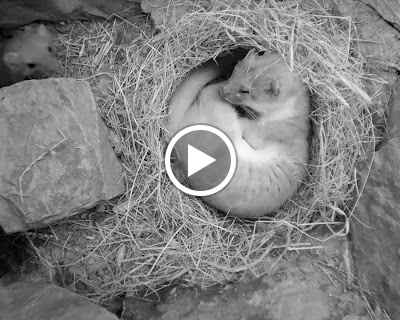
I've been watching this pair of wild stoats via a camera hidden in their nest and I've discovered some really interesting behaviour. Below is my latest footage. 


It shows a the male curled up asleep in the nest when the female enters and tries to engage with him. She is very cautious about waking him and slinks gently up alongside him, momentarily resting her head on his back. However he's not about to get up and barely moves a muscle, gazing at her through one eye until she retreats back outside again.

But what is really interesting is the sounds that they make. For such notoriously viscous creatures, they sound like gently chirruping guinea pigs or soft bird chatter!


Friday, April 15, 2016

Unseasonal Snow Hares


It's lovely to see a little sunshine today, perhaps spring really is on its way.
What a strange, warm, wet, windy winter it’s been. The bats have stayed on the wing, hedgehogs have barely bothered to hibernate, butterflies, blossom and daffodils have all made unusual appearances: it’s been tempting to think ‘What Winter?’
This was despite MET Office predictions last October for the coldest and most severe winter on record. The hype about this bitter forecast reached fever pitch when a Bewick’s swan made it onto the national news when it arrived from Siberia two weeks earlier than usual.
At the time, I was in a meeting in Bristol to discuss ideas for wildlife topics for The One Show.
The BBC1 series producer wanted my input for a new series of wildlife related pieces and I suggested a snow safari to look for owls, and hares. The plan was to show how hares breed and box all year round. The producers jumped at the idea and commissioned a four and a half minute piece.
I came home and made initial preparations. In order to photograph wildlife up close it is important to blend into the background. I have had plenty of practice and have a few tricks up my sleeve: a snow white ski suit, a balaclava made out of a pillowcase, white oven gloves and tailored white covers  to wrap around my camera and tripod.


I had enough of this white camouflage for myself but I bought extra for the film crew and presenters.
All we needed now was snow. Many don’t like snow, but I love it. There is nothing that transforms the landscape so fast. Overnight you find yourself in a totally different environment and this can present so many opportunities for my photography and artwork.
We had a flurry  in November but it didn't last the day. This was followed by so many wet and windy storms I was getting worried the MET office, that was using the alphabet to give each storm a sequential name, would run out of letters.
Then finally in January the snow came. Not a lot, but enough for me to get some video footage of the hares before inviting the rest of the crew for the main shoot.
I drove to some fields where I often see hares. And sure enough, I spotted a few in the distance straight away. They looked like specks of brown on a pure white background. But I wanted to find a larger group so that I could film the interactions between them.


I scanned the landscape with my binoculars and soon spotted a group of eight on a distant field. I continued my search and picked out a further 30 hares, some of them actually boxing.
This field was clearly the place to go for. I rang the landowner to get permission to film and then set off. Dressed in a white ski suit I headed up a tram line, made by a tractor wheel, which took me directly towards the hares.
It was slow going. I wanted to get close enough to the hares to film them so I gradually walked closer, stopping whenever they showed signs of having spotted me.  It was like a game of grandmother’s footsteps.
After a couple of hours I was in photographing range of eight hares, frolicking in the snow. The group seemed to have got used to my presence.
I didn’t manage to film any actual full-on boxing but I had shots of some chasing one another about and even a few spats. Then I heard a dog yapping. Suddenly more hares came over the brow of the hill in front of me. The hares that I had been watching flattened their ears and squatted to the ground. Some of them dashed off. There were hares running in all directions. Then a lurcher ran across the field in hot pursuit of a hare, followed by a yappy mongrel .
The dogs disappeared. But now there was not a hare in sight.
They weren’t  poachers’ running dogs. The yappy crossbreed wouldn’t be fast enough to catch a hare. After a while some of the buck hares came back into the field looking for the does. But they were very jumpy and soon dashed off again.


Feeling disgruntled, I headed off to a different field on the other side of the valley. There, I spotted two more groups. One of eight and one of 10, with a few stragglers around the edges of each. I headed to the smallest and nearest group.
I started making my approach slowly and then out of nowhere a bank of fog rolled in and enveloped me. I couldn’t see a thing. It was like being in a giant white margarine tub.
I heard the faint call of a grey partridge. The sound got gradually louder and louder and then a ghostly partridge appeared out of the mist, running and calling. I watched as its silhouette disappeared and faded into the fog, along with its call.
Alone again I tried to navigate by looking at my footsteps behind me. As long as these were in a straight line, I judged that I was still going towards the group of hares.


Then a hare burst out of a snow hole and dashed away from me. Finally my eye had something to focus on. The stray hare ran straight into the group of hares. They looked like ghosts in the distance, all standing to attention, ears, eyes and noses alert to danger. I waited for them to settle before slowly edging forward. Then suddenly, explosively they all ran at once away into the fog.
I decided to try my luck with the group that had been further down the field. Again, as I made my way blindly across the field, I bumped in to a straggler. He ran down the field and disappeared into the whiteness. I then spotted the larger group of hares. I had to tread really carefully. There were even more eyes and ears to spot me this time.
I took eight steps forward. Then stopped for a few minutes. Then I took  another eight. As I got closer I reduced it to six steps. Then four steps. I was watching the hares all the time. Any twitch of an ear or tilt of a head and I would stop for as long as it took to settle back down.
Then I saw a buck try his luck with a female. He sniffed at her but she looked less than interested and hunkered further down into the snow. Another buck chased this rival off in a circle around the group. There were two females amongst them - I could tell they were female by the obvious attention they got from the bucks and by the fact that they were slightly smaller with finer heads and paler fur than the more ginger bucks. Their body posture also gave them away. They tended to stay huddled down in the snow, defensively.
At last the fog began to clear. I watched the group for an hour. It was fascinating seeing the bucks jostling for position in the group and amusing to see how all their antics did little to impress the females who continued to hunker down into the snow.
I edged forward. Then without warning one of the females took flight, taking the bucks with her on a race across the field. She would only choose the fittest and strongest male to mate.
Then I saw her start to box. Snow and fur went flying as the pair fought it out, both standing bolt upright on their hind legs. Frustratingly they were too far away to film.
The race continued on to the next field and out of sight. I had only just one female hare left in front of me now. I got down low into the snow and on my hands and knees crept closer and closer until I was within 12 metres of her. She stayed in the same huddled position the whole time, like a compacted sculpture.
Then she got up and casually started eating her own droppings. Surprisingly, these retain some of their nutritional value. This wasn't the dramatic film of boxing hares that I had envisaged. But it was interesting behaviour nonetheless.


Wednesday, March 23, 2016

The making of an underground hide.

The pipes have arrived for the tunnel I'm making so that I can get from the house to a new hide without being detected.


It is going to run from my back door along the side of the house into a hide opposite where my stoats appear so that I can get out and be at eye level to photograph them without disturbing them.


It's turned out to be a big project - not sure the family are that keen on the disruption to the garden!

An egg-rolling stoat for Easter

Egg-rolling is an ancient Easter tradition, but who knew stoats did it too!! Watch as this stoat nudges an egg down a hill, negotiating a old log and off to its secret stash.


Well, actually I have seen them rolling eggs before, but only wild pheasant eggs. I wanted to see if I could get one to roll a hen's egg for Easter so I left one out for it in the garden. At first it was cautious and just bounced around the egg, investigating.


But later that night it returned. I filmed the moment the stoat appeared from behind a branch and cautiously approached the egg. Then it recoiled its neck, as if in surprise, before returning to examine it and then gently nosing it across the grass. 


The stoat rolled the egg across the garden and down the hill, carefully nudging it round hillocks and over tough grass - off to stash it somewhere for a quiet meal later. I've noticed that the stoats in my garden are particularly playful. They actually climb onto the cabbage netting in the vegetable patch and bounce like kids on a trampoline.

I wondered if one would attempt to roll an egg over the unsteady surface so I set up my camera to watch. Sure enough it approached the egg and confidently began to nose it ahead of itself. Watch how the stoat manoeuvres the large hen's egg in and out of the rolling depressions made by its weight on the wobbly cabbage netting.


Friday, March 18, 2016

A fussy tawny owl


This female tawny owl is being particularly fussy. The male wants her to nest in a particular nest box close to where I have been leaving food out for it. It suits the male to choose this box to nest in as he knows there will be a constant supply of food here and it suits me as I have hidden cameras in the box so that I can watch what happens once the eggs are laid and chicks hatched.

But so far she won't comply.  Every night for the last month or so the male has perched outside this box calling out in a gentle ocarina trill, the continuous cooing sound made by males to attract females, but she has ignored him.

I finally caught the moment when she deigned to have a look round on camera. She flies into the box carrying a woodmouse, which I suspect is an offering from the male and appears to glance round briefly before tucking into the mouse.

But she doesn't get stuck in. Instead she leaves the mouse, gives the nest box a second brief inspection, spinning her head round to size up its possibilities, and then leaves.


This doesn't look too hopeful! She's being very fussy and I've noticed she keeps going in to other nest boxes in the area as if she's trying to say, "Look this one's much better," He's been very patient!

Watch the video here:


A Robin with Expensive Tastes

The robins have been trying to nest in the spare wheel of my Landcruiser - again!


I spent some weeks last year trying to deter a pair from the vehicle - even driving it 40m away to the car park outside my gallery, but the robins kept finding it and carrying on with their construction! Eventually they stopped - only to then adopt the grill of the Landrover!


I ended up grounding the vehicle for the entire nesting period, which in total was 38 days. It occurred to me after watching them stuff the front grill with leaves and moss, that these robins had probably adopted the most expensive nest box ever!

Still it was quite rewarding to then see the young chicks fledge from under the grill. It was quite amusing watching them neatly tucked away under the shelter of the car. The adult pair sat on the eggs for 17 days. It was difficult to see if any chicks had hatched as they were so tucked away inside the car. But one day the adults started following me around the garden until I put more food for them. I knew this was a sign that the chicks had hatched as they needed extra food to feed their young.

But whilst I enjoyed watching them, I need to be able to use my cars and can't really afford to turn them into nest boxes. So this year I was ready. As soon as I saw some interest in the back tyre of the Landcruiser I moved the vehicle and instead propped an old tyre onto the hedge next to where the Landcruiser had been parked. 


So far they seem to like the idea and the tyre has been filling up with nesting material. Robins are famous for choosing all kinds of unlikely locations to nest in and seem unafraid of raising their broods amidst human activity. I've had them nesting in an old kettle in the garden before and even an old boot. 

This pair are so at home in my garden they have taken to perching on my wife's bicycle. I've stocked up on extra mealworms to offer them for once the eggs hatch!