Shortly before Christmas I drove to Donna Nook in Lincolnshire to see the seals. Grey seals come here each winter in their 1000s to pup and to breed.
 Maternal care in seals is very short-lived. It lasts just two to three weeks. The pups are weaned after an average of 18 days.

Seal milk is very rich though. It is made up of 52pc fat and 11pc protein - cows milk has just 3pc fat, 3pc protein and 88pc water!
The pups put on weight very quickly - an average of 1.7kg a day. By the end of the suckling period they have trebled their birth weight. The mother, in contrast, loses weight, about 3.8kg a day. 
This pup is just three days old. It's skin looks loose and wrinkly but it will soon grow into it.

This pup is roughly three weeks old, already weaned and ready to make its first journey out to sea. Pups stay on the beach for at least a week after weaning. It's fun to watch them get more alert and playful.

Because they are no longer feeding, they rely on the blubber they have accumulated while feeding from their mothers. But they do lose about 1.4kg a day for the first three days and then 1kg a day after that.

I spent quite a long time photographing this pup. It was the cleanest on the beach and was lying on a large patch of ice with gave me a clean background.
 I could have been in the arctic.


 In some photographs I deliberately over-exposed the pictures to soften the edges and to make the eyes and muzzles of the seal pups stand out all the more.

Females are ready to mate just three weeks after pupping.  Males lies close to the females in order to defend her from other males.

Males lies close to the females in order to defend her from other males. I saw this female taking a well-earned break in a shallow pool.
The male seals are like heavyweight champions. This male bore the bloody scars of a recent battle.
 A grey seal's long whiskers help them to locate food in poor visibility.
 Grey seals also moult whilst they are on shore. This male was looking particularly patchy.


 There was 18 inches of snow on top of the ant hill and it soon gave up.


 Woodcock is one of Europe's most elusive birds and although readily spotted when flushed by beaters on shoot days, it is rarely seen naturally foraging on the ground.
 But since the ground has been frozen solid I've been able to watch this enigmatic bird at close quarters.
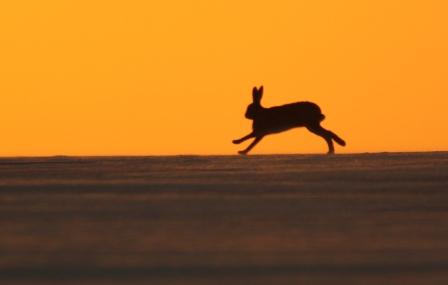
 These running hares reminded me of one of my best-selling paintings, 'Hares on The Run'.
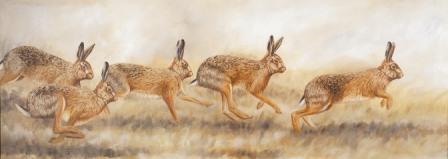
 The lead hare is a female with the males running enthusiastically after them.
 She runs to test their strength. Eventually she will mate with the fastest and fittest.
 They have had to resort to eating twigs and bark on the hedges, though.


 This one froze on the spot as soon as he got downwind of me and picked up my scent.
 He then briefly stepped closer to investigate me.
 Before dashing off into the distance.

 But for a wildlife enthusiast such as myself it has provided one of the most exciting photographic opportunities ever.


 Stretch.
 And then resume courting. Here the one of the males dared to test the female's scent.
 But here a female rebuffed the male's amorous advance with a swift box that sent him springing.
 After several days of snow storms, I was glad of some good light on a crisp sunny day and although it was -14C when I set out the bright light and heat haze coming off the snow played havoc with my auto-focussing.
 The sunlight also put paid to my disguise since the hares could also hear my every footstep