Monday, March 10, 2014

A Good Hare Day

 
It’s Mad March Hare month again - my favourite time to spot boxing hares in the fields.

Although there are no shortages of them here on the Yorkshire Wolds, to get photographs good enough to paint from, like these, is always a challenge.


The large arable fields leave little cover for a 6ft2” artist like me with a cumbersome camera and tripod.

But last week I stumbled upon a group of six hares and, knowing that hares are usually solitary unless they are courting, I set out to watch them. 

I could see the female squatting inside a ring of males As I crept into position behind a hedge, a buck stood on its hind legs and started shadow boxing, like professional boxer limbering up.


The female rose and stretched. The dominant male took this as a sign that it was time to try his luck and tentatively, sniffed at her. But his cautious approach, intended to test the female’s receptivity, was rebuffed with lunging paws.


I watched as the other males ran in. A flurry of boxing broke out. Chaos ensued as hares leaped up into the air and crashed down onto each other. I lost track of who was who until things calmed down.


The females urinated and the males rushed over to test the scent and jostled to see who could roll in it first.


This added to the confusion. The males that had rolled in the female’s ‘perfume’ now smelt of females themselves and they were running round confused, sniffing one another.

The doe took advantage of the commotion and ran off. Then the chase was on. The doe likes to test her suitors in this way. If they can’t keep up then they are out of the picture. She only wants the fittest and smartest to father her young.

She zig-zagged as she ran, using a hedge for cover. But then, to her own surprise, she outsmarted all her suitors. Like a real flirt, she returned across the field and back to where it had all started, as if to she was encouraging them to catch up.


The chase was on again and a flurry of boxing broke out between the doe and one suitor.

After such a great morning I felt inspired to get my sketchbook out. I hope some of these will develop into a new painting.

www.robertefuller.com

Monday, March 3, 2014

Nest Box Wars Commence!


Spring is in the air and nest box 'wars' have begun. I've been following the antics of a pair of kestrels and a pair of tawny owls from my studio window for many years.


This week I saw the kestrels mating. They are starting to look for somewhere to nest, but to their horror, they found the tawny owls sitting in the nest box that they had used last year and they were not happy.

The kestrels dive bombed the nest box all week in an attempt to get the tawny owls out. But the tawny owls weren't for moving so the kestrels upped the anti and sat in the nest box that the tawnys usually use. I'm not convinced it's all over - last year all this went on well into April.

 
Still, with a bit of luck I should be watching tawny chicks (above) and kestrel chicks (below) in the summer.


And as if this wasn't enough, jackdaws are also looking - up to six have been taunting the kestrels - and stock doves have been hanging around the nest sites too.

There is always a tussle for the best sites and usually the tawny owls get the first pick. I've been building some new nest boxes today and hope to get them up by next weekend to relieve the pressure - I wonder who will be the first taker?

 
And further from home, owls were also on the agenda as I drove across to Cumbria to The World Owl Trust to meet the its president, Tony Warburton.
 
 
I had gone to visit after I was asked to become a patron of the trust, a position I was very proud to accept.
 
We talked about owl conservation all over the world and it was interesting to learn about the plight of burrowing owls in America and of their conservation projects in the Philippines.
 
 
As for the UK, we discussed the importance of preserving natural grasslands. The diet of the barn owl is the short tailed field vole which needs tussocky grass to thrive. 97% of this type of habitat has been lost due to modern farming methods. Even the verges alongside country lanes are now often kept closely mown 'neat and tidy' and voles have nowhere to live. It's no wonder barn owls are on the brink of survival. 

On top of this the cold spring we had last year meant we had a drop in vole populations and this led to a dramatic decline in breeding barn owl pairs – Tony reckoned it was the worst breeding season since 1958! I was so worried that the winter might finish off the few remaining pairs near me that I decided to start supplement feeding several pairs in the autumn.
 
 
It has been a rewarding project as one particular pair has become so accustomed to my visits that the male actually took food from the top of my hat the other day! Above is one of the first attempts at photographing them. It's tricky to get the exposure right, so its work in progress and I'm looking forward to lighter nights too.
 
Initially I fed these owls on mice that I trap in my garden, but once I got them taking the mice readily from the landing platform outside the nest box, I switched them to day old chicks which were easier for them to spot on a nearby fence post.

These chicks are a by-product of the egg industry. I’m hoping that this pair at least, out of a number that I have supported through the winter, will be strong enough to breed this year and restore the fragile population here on the Wolds.
 
Of course I might also get some good paintings of them completed before the year is out too! This is a painting of what I'm hoping for later on in the year....


Monday, February 24, 2014

How I Built an Artificial Fox Earth

You may remember my plans to build an artificial fox earth so that I can attract a vixen? This is how it looks now it’s finished. The green bank at the back is to give my photographs a green background…..


And this is how I built it. It took some doing! Three men and a mini-digger in the wind and the rain… let’s hope the vixen takes to it!


This is the chamber I built to go inside it. It is basically an upside down plastic pallet box, lined with wood to prevent condensation. It also has a weld-mesh floor to prevent animals such as badgers digging out from under it, covered with soil, dry bracken and leaves.


Inside is an infra-red camera with a cable that leads to a hide that I have positioned nearby to watch from.

I set the box into a four-foot hole and then dug two six metre channels leading away from it. Into these I laid two 10 inch pipes, before covering the whole thing up again with soil and moss and turf.


Now all I have to do is stay away for a little while so that the foxes there feel confident to go and explore.

The good news is that as I walked up to the site before we set to with the digger, there was a strong smell of fox so there are definitely some about.

Foxes will have just finished courting now and I expect that the vixens will be looking for a safe den over the next few weeks. Fingers crossed!

I painted this just before Christmas. This is the sort of shot I want to get to give me some new ideas for compositions.

Monday, February 17, 2014

Sketching Buzzards


I sketched these buzzards some years ago. They make such nice subjects to paint.


But recently I've been fascinated by a pair circling in the valley below my studio and decided it was time to start a new composition. It took me a long time to get up close to them. I set up a feeding station in a valley close to my home and gallery in Thixendale, North Yorkshire, last autumn, and I am only just starting to get the shots I need.


It took me a while to get them feeding regularly but thankfully the process has had other benefits. It helped me out with a problem I have living in a rural setting: rats. All winter-long I battle with these unpleasant invaders. They come off the fields after harvest and head for the house and outbuildings - even trying to dig down under the bricks to tunnel their way in. I am against using poison because of the impact it would have on the rest of the wildlife that thrives here and so my only option is to trap them. It’s a nasty job, especially when it comes to disposing of the carcasses.


Then I thought I could turn the rats into buzzard-bait. Most birds of prey, except buzzards and red kites, find rats too tough and even a fox will turn its nose up at one. But thankfully buzzards are partial to them.

I fed the buzzards every day for two months before I dared put up a hide without disturbing them. Even then my first attempt scared them off. It took me another 10 days to re-acclimatise them. Finally after three months, and 85 rats, I’d done it and they were feeding there regularly.


After a full morning of sitting in my hide watching, I managed to get these shots of the female posturing to make herself look large when her mate flew in to join her.


I think this photograph could make a suitable pose for a new painting. What do you think?


Thursday, February 13, 2014

How will you by 'showing the lurve' on Valentine's Day?

Here's some wild ways to go for it! I filmed this footage whilst studying different courting behaviour..

Monday, February 10, 2014

New BBC Wildlife Local Patch Reporter!

Hello, I’m delighted to introduce myself as a new local patch reporter for BBC Wildlife Magazine.


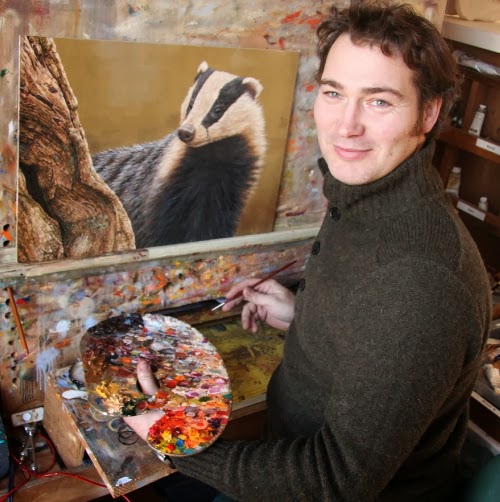
I am a wildlife artist and will be bringing you a painter’s perspective on the comings and goings of all the wild animals on my patch.

This will include all the latest news on my wild painting models, some of them new subjects and many of them old hands at posing for their portraits in exchange for titbits or a nest box.

I use my photographs and sketches as reference and sometimes I get just the right pose to paint from.


Over the next year I will be keeping you up to date on a pair of tawny owls that I feed in my garden as well as reporting from a badger sett where they have accepted me as part of the clan and allow me to walk among them.


I have lived in this area for most of my life and my knowledge of the local wildlife stretches back many years.


Most of the badgers, foxes, deer and owls around here are a bit like old friends. I catch up with them most days to see how they are doing.

I spend as much time as I can out watching wildlife, but over the years I have also adapted my garden so that the local wildlife can come to me.


I’ve planted a wildlife meadow and woodland and have dug a pond to attract the birdlife. Among the many garden birds that now visit is a colony of more than 60 tree sparrows. I’ve even had redstart in the summer and there is a pair of kestrels that have nested in the garden. 

So, many of the stories I will be sharing with you will be about the wildlife that I can see from my studio window.

At the weekend I started to build a false earth for foxes. My plan is to attract a vixen and then photograph the cubs from a sunken hide. I’ll let you know how I get on.


While I was there I checked to see if the kingfishers were about. There was no sign but I’m still hopeful that they will be back because last year I built an artificial bank (pictured) there for them to nest in. It has two secret chambers, one for the kingfishers to nest in one and for me to watch them from.

On my way home I spotted a barn owl. It has been raining heavily here all week and this one was taking advantage of a dry spell to go out hunting.


Barn owls are my favourite bird of prey and so expect lots of news about how the pairs nearest me are doing.

In my spare time I’m involved in a conservation project to help protect these beautiful birds of prey and I’ll be checking some of the 150 nest boxes that I have put up on farmland around here. I like to paint barn owls best – as you no doubt will find out!


Wednesday, January 29, 2014

Courting fox

The foxes in Thixendale have begun courting. I've been out listening for their calls and so far I've tracked five in the vicinity.

Fox on the Lookout, limited edition print 

Then last night I spotted a lone vixen and followed her because this year I have an ambitious plan: I want to build an artificial fox earth and try to encourage the vixen to bring up her cubs there.

The idea is to then build a sunken hide into the mound from where I can watch the cubs as they emerge in the spring. It will mean tracking her comings and goings very closely.

In the meantime I've begun working on the composition of a new painting of a fox pair. I like to cut up my photographic studies and play about with them on a plain background until I'm happy.